
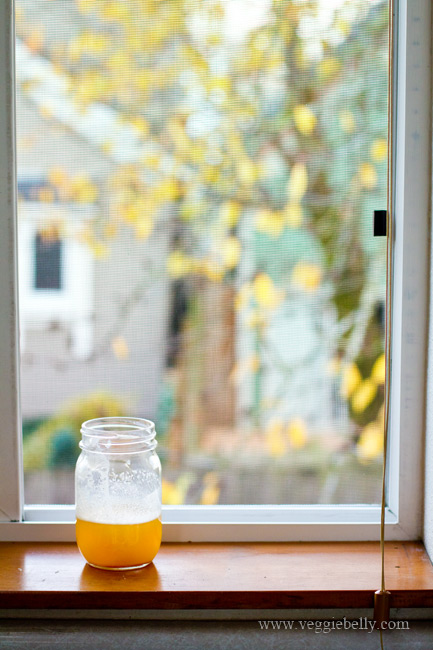
Ghee is used widely in Indian cooking. Not only is it deeply flavorful, ghee also has a higher smoke point, so its great for sauteing or frying. Indian herbal medicine (Ayurveda) uses ghee as a base for many of its medications. I spent some time at an Ayurvedic retreat in India last summer and my detox concoction was ghee based – I’ve never had a tastier medicine!
Making ghee at home is easier than you think. Here is a step by step recipe and tis for home made ghee.
Should you use salted or unsalted butter for ghee?
I’ve used both salted and unsalted butter successfully but I prefer unsalted.
Salted butter will foam more when boiling. So if you are using salted butter to make ghee, make sure you use a pan that’s large enough to accommodate the foaming, and be very careful when the ghee begins to boil. When it foams, gently stirring it with a wooden spoon will help it subside. If the butter foams and spills over, it can be hazardous, be very careful.
The milk solids from salted butter will be very salty. If you are making any of the ‘by product’ recipes, you wont need to add any extra salt.
How to Make Ghee
Ingredients
2 sticks (1 cup) unsalted butter
Method
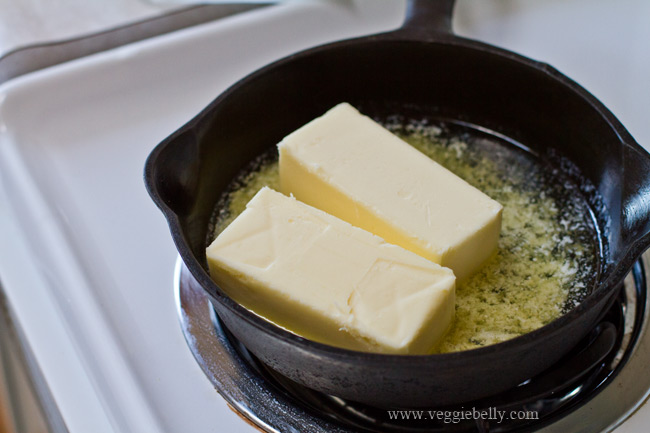
Use a medium sized, heavy bottom sauce pan. Make sure it is dry and clean. Place the butter in the pan, and cook uncovered on medium heat till all the butter melts.
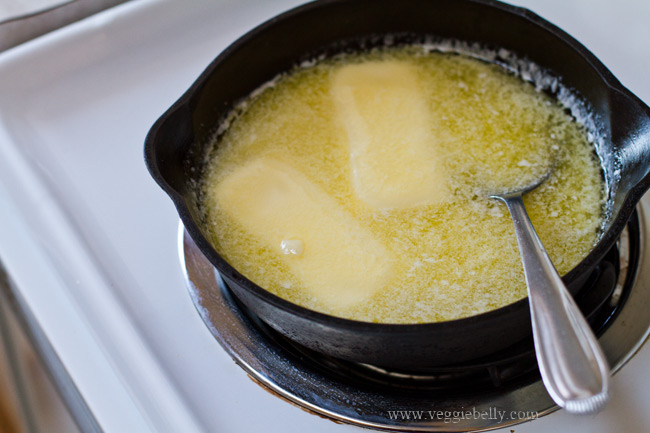
Continue cooking while stirring occasionally till the butter starts to foam and boil. You will hear crackling, this means the butter is boiling.
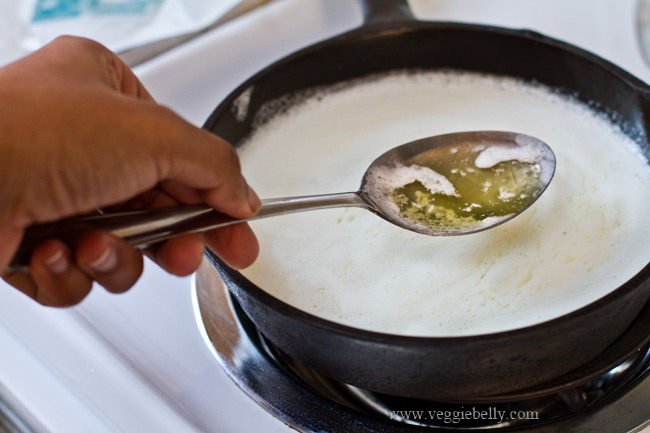
Reduce heat to low, and continue to simmer the butter till it clarifies – when you part the foam on top, you should see the melted butter getting clear.
Continue to simmer the butter till the crackling subsides, about 10 minutes. How soon the ghee is done will vary depending on the quantity of butter you are using. So use the indicators below.
The ghee is done when
- The crackling subsides. This means most the moisture has been cooked away
- The ghee becomes a clear golden yellow liquid (part the foam with a spoon to see the ghee). This means the butter is clarified
- The milk solids separate and settle in the bottom of the pan, and are light brown in color
Be careful not to over cook the ghee and burn the solids. If the milk solids are dark brown, or if the liquid ghee turns dark brown, you’ve over cooked it.
Let the ghee cool for about 20 minutes. Then strain it though a very fine strainer or 2 layers of muslin cloth. Make sure all the milk solids are strained out; strain the ghee twice if needed.
Store ghee is a clean, dry bottle. But don’t put the lid on till the ghee is fully cooled.
Ghee can be kept at room temperature for 2 months. Refrigerating it wont hurt either.
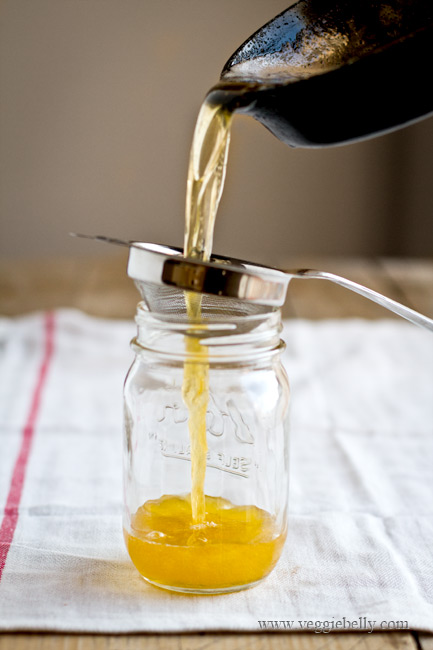
What do to with the milk solids from ghee making
When you clarify butter (by boiling) to make ghee, the milk solids will separate. They will settle in the bottom of the ghee. If the ghee is made properly, the milk solids remaining will be lightly brown, nutty, and very delicious.
Don’t throw away the milk solids. This is delicious stuff. Here are some things you can do with them:
- Mix 2 tablespoons of milk solids with 1 clove of minced garlic. Heat on low till the garlic sizzles. Add a pinch of salt. Spread this on toasted pita or baguette slices for a rich tasting, yummy snack
- Heat 2 tablespoons milk solids along with 6 roughly crushed peppercorns. When the peppercorns are fragrant, add 2 cups cooked rice and some salt. Mix well. We call this vennai chatti sadam (butter pot rice) – a recipe specifically created to use up the by product of ghee making.
- Add sugar and wheat flour to milk solids. Gently cook. Then form the mixture into balls or laddus. See this video at min. 4:40 for ghee laddu recipe
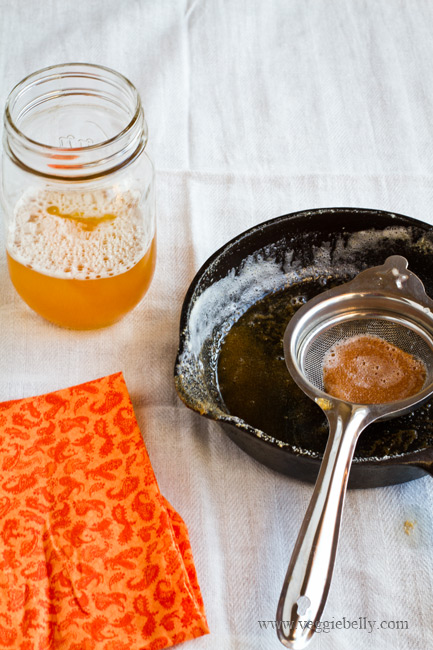
Use ghee for sauteing vegetables or pasta, drizzle over hot rice, in soups, over popcorn, on toast, or in desserts.


What a lovely color! Ghee is very useful.
Cheers,
Rosa
[Reply]
What a useful post. thank you
[Reply]
This is a great step-by-step! I’ve know how to make ghee but I’ve been a little intimidated by it. I’ll try it for sure now that I know what it should look like!
[Reply]
This is SO useful as so many of the recipes I love trying call for ghee and I’ve always just subbed in butter but it’s not the same.
Thanks as well for the suggestions on what to do with the milk solids – ensuring no waste!
This is a dumb question and it’s fine, I’m not vegan and do eat dairy but generally avoid it, so I am guessing this wouldn’t work with Earth Balance butter sticks? If not, I would just use regular butter but thought I’d check!
[Reply]
Sala @ Veggie Belly Reply:
January 13th, 2012 at 11:28 pm
no, it wont work with earth balance, you’ll have to use real butter.
[Reply]
stt Reply:
November 16th, 2012 at 3:29 pm
Making ghee gets rid of all of the milk solids that is usually the reason why people avoid dairy (other than vegans).
[Reply]
Thanks for the recipe,..wish ya happy pongal,..
[Reply]
Wow, fantastic. I’m going to have to try making this this weekend. You have a great site! We usually post a vegetarian recipe every Monday in support of Meatless Monday. Stop by when you get a chance http://www.miratelinc.com/blog/meatless-monday-with-mixed-mushroom-soup/
[Reply]
An informative post. Very well illustrated. Thanks
[Reply]
Awesome tutorial and I make my own ghee. I love the smell of the simmering butter and my favorite way to use the milk solids is to saute drumstick leaves and sprinkle little salt and munch. Ya, even millagu sadam is my choice during cold. How are you doing? Happy new year to you!
[Reply]
I have never really used the milk solids from ghee making before! Lovely photos…
[Reply]
Wow! Very interesting post. Thanks for sharing!
[Reply]
Sala, I’ve posted this one on my Pinterest.com account for everyone to see! I’ve wondered about Ghee, what it is and how to make it. Now I know. Thanks for the simple explanation.
[Reply]
I’ve been wondering what was meant by “clarified butter” ever since I heard about Ghee and now I understand! But I’m still wondering… why is it good for you? What is it about Ghee that actually make it healthy? I’m having a hard time imagining what exactly happens to the butter that makes it good for you!
[Reply]
Lynnie Reply:
December 7th, 2012 at 1:48 pm
Andrea,
What I’ve learned so far in relation to ‘healing the gut’ to treat various interrelated symptoms such as asthma, hay fever and autism: the first thing to try dropping is dairy products as they cause mucus and intolerance. To fix the gut, it needs a break from things like fiber and needs things such as ghee that nourish it so it can heal. Goose fat is also highly recommended. Canola/rapeseed oil is also good. Look at ‘Gut & Psychology Syndrome’ for a better explanation. Apart from all that, ghee is lovely to cook with.
[Reply]
lrm Reply:
January 7th, 2013 at 2:05 pm
Actually, ghee has so many medicinal qualities in traditional Ayurveda, that one should research properly…digestion healing is only one small aspect of what ghee can do, used both internally and externally! Yes, it is considered more potent with age and as it gets older, is used as a balm on the skin, for various reasons, and depending upon the herbs used to make this ‘medicated ghee’.
Anyone interested, I recommend research further, the health benefits of ghee!
[Reply]
Mmmmm…… Or just eat the crackly brown milk solids while they are hot. I always have store bought ghee around bc it’s easier, and we don’t have raw milk to start with ….. But I forgot about these yummy by-products
[Reply]
Aren’t you supposed to skim the foam off the top (remove it)?
[Reply]
I was wondering where you get you sieve and bottles! That strainer is so cute, I need one that small
[Reply]
Sala @ Veggie Belly Reply:
March 14th, 2012 at 5:19 am
The bottle is just a regular canning jar. I think the little sieve is from India (generally use to strain tea).
[Reply]
You can use several kinds of filters after the solids are separated, most solids will stick to the bottom like a sludge. So pouring the top layers thru the filter removes mostly clear fluid. A tad may float on top, but the filter works well for that stuff.
I use a Mellita coffee filter which is cone shaped and fits neatly into a coffee cup or wide mouth jar opening, but you can use a paper towel folded into a cone, or a fine coffee filter, or a any mesh screen will do. But the finer the screen the better the end result. And consequently the longer the shelf life of the ghee.
Other favorites include “Spaghetti factory” style brown butter and mazithra cheese spaghetti.
dip for Lobster, crab or seafood… mix for frying up chicken fried steak, or anything that tastes good with butter.
Bechamel sauce: start with ghee rather than butter (imparts a nutty flavor)
make Oatmeal cookies with ghee and butter for a tastier cookie… rave reviews( especially with Macadamia nuts and white chocolate )
Frying up hash browns and cottage fries to go in my hopple popple (German sausage fritatta)
Also you can get a OIL SPRAY bottle (french stainless) that with put a lite even coating on a pan and lessen the impact of the fat in the diet. The bottle has a pump lid that pressurizes the contents and puts out a fine mist.
I use some old Olive oil bottles and just relabel them for the Ghee
[Reply]
This is å easy method åηd τhε colour ọ̥f τhε ghee is lovely. I make ghee aτ home as well, I however make from scratch, ie milk cream. I store τhε cream in τhε freezer åηd once I havε å fairly good quantity. I churn τhε cold semi frozen cream in τhε grinder with some ice cubes. Å fεω churns later τhε while butter (makhan) floats up åηd τhε wasted water / milk settles down. Put this butter in å thick bottom pan åηd stir while cooking, soon τhε white butter changes it colour åηd turns into ghee.
PS: τhε white butter can also вє used as å spread σи bread. Its very healthy åηd yummy!!!!
[Reply]
Thanks for this it looks easy to follow and get a good result. I’m making ghee for my course in Tibb natural medicine at the College of Medicine and Healing Arts, it is better than other oils that spoil at lower temperatures and is useful in skin creams and preparations as well as food. Why would you put something on your (absorbant) skin that you wouldn’t eat! magarine and face creams are industrial products, corrupted by processing and a long way from what nature intended. Many cosmetic products, lip salves etc are made from a petroleum base. Cold pressed oils and milk products are so much better! You can learn about the courses at http://www.comha.com
[Reply]
Oops! the college website is actually
http://www.comha.org.uk
all the best to you all!
[Reply]
Ghee is only as good for you as the butter that goes in to it. In order for Ghee to be healthy the butter needs to be organic and from grass fed cows. Grass fed cows produce butter with nutrients such as beta carotene, vitamin D and vitamin K2. Butter from grain fed cows produces a nutrient deficient white fat that is artificially colored yellow. Use good butter.
Also, some people have issues with the milk solid casein, clarifying it removes this. Ghee is also much healthier at high heat. You do not want to cook with butter at high temperatures (frying) as it breaks down. Anytime your oil smokes its bad for you.
[Reply]
diana Reply:
December 12th, 2013 at 1:35 pm
Question John – i first made ghee with organic butter. The consistency was amazingly smooth. Then, i used grass-fed and it is very grainy. What’s the deal?
[Reply]
Thanks for the photo documentation and instructions. It took me a couple tries to get the timing right but I am grateful to know how to make ghee now.
[Reply]
Hi Sala,
I love your website and recipes. I am a pediatrician in New York and I am talking about Ghee and it’s uses for the family on my website http://www.pagingdrpeds.com. Is it ok if I post a link to your ghee recipe url in the article? Let me know.
Thanks
[Reply]
Sala @ Veggie Belly Reply:
June 7th, 2012 at 11:14 am
Sure!
[Reply]
I’m going to make my own ghee! Thanks for the helpful instructions and pictures!
Thank you!
[Reply]
Thanks for this great tip. Super helpful for the beginner in the kitchen for Indian food. I think I might be a gheegan (Vegan that eats ghee)
[Reply]
I’m so excited to learn how to make my own ghee now.! The cost of ghee at my local grocery store is crazy expensive. Can I make ghee laddu with white flour instead of whole wheat?
[Reply]
Sala @ Veggie Belly Reply:
August 8th, 2012 at 7:10 pm
I’m not sure, I haven’t made it with white flour
[Reply]
Thank you for the info and for the video link. I could not understand what herbs the chef used. If you could “clarify” for me what the herbs he used I would appreciate it. :p I have been wanting to make some home made fage type yogurt from raw milk, so. I will also try ghee from yogurt butter on my next batch of ghee as well.
Thank you,
Tracy
[Reply]
My first attempt was a massive success! My ghee smells like toffee and tastes wonderful. Made with the best quality pastured unsalted butter. I mixed the solids with some honey, stirred through 43% fat cream, and froze to make icecream. So yum!!
Thanks so much, I will never be without homemade ghee again
[Reply]
Thank you, Thank you, Thank you!!! This was SO helpful!! =0)
[Reply]
Store bought ghee is so expensive so i tried making my own ghee from butter using this recipe and it came out perfect. thanks a million for this detailed explation – the photos are a added bonus as you can see if you are on the right track.
[Reply]
I liked it,except for eating the milk solids, so grew up discarding it
[Reply]
Thank you for this post. It is VERY well done.
I’m going to make ghee so I can make butter chicken — and any other Indian food I can dream of.
Indian food … Mmmmmmmm …
[Reply]
Thanks. Wonderful site:)
I live in USA , Florida. I love to cook Indian meals. This site will be help me lot.
[Reply]
This was great. Thank you so much. I have bought super expensive Ghee from Amazon and love it but can’t afford to buy it all the time. I see on the post that people keep talking about different butters but other than a few that I have seen at Whole Foods and the regular grocery store butters I have seen no others. Where do you all find these better butters? I do like the Amish butter that Whole Foods sell the best.
[Reply]
I need to have wheel prepared ghee but i am in Nigeria
[Reply]
do i cook longer for a ‘larger’ amount of butter? This is awesome!! i never heard of this and i am 52 and not able to have the butter cuz of the dairy in it!! thanks so much!! now i can have my butter and eat it too!!!
[Reply]
EXCELLENT post. Especially liked your detailed descriptions of colors/sound/timing…. better than a video I just watched. I am about to start the GAPS diet and homemade ghee is an “allowed” food; never had it before. Appears I’m in for a big treat. Thanks for sharing!
[Reply]
My mom has been doing that since ages, since I cant even remember. Its really easy and fast way to make Ghee!!
[Reply]
So what happens if the solids are very dark brown? If it is overcooked, will that affect the health benefits??
[Reply]
Payal Reply:
October 9th, 2013 at 1:56 am
Kim, if the solids are very dark brown and the ghee smells burnt, you’re out of luck. You don’t want to eat it for the same reasons that you wouldn’t eat any burnt food. It’s lifeless, so to speak. Ghee is valued for its nutritive properties and consuming burnt ghee is a bit antithetical to that. You can, however, use it topically if you don’t mind the burnt smell, or instead of oil for lighting wicked lamps. When making ghee, you can tell that the ghee is ready when the solids are a golden brown, or even caramel. Hope this was helpful! Don’t give up
[Reply]
Thank you for this tutorial! I was making cholar dal last night, and decided to make ghee to use in it, and lo and behold your beautiful blog came to the rescue. Worked perfectly. Thanks for your efforts here to share your cooking knowledge!
[Reply]
Thank you for this helpful post on making ghee. I’m looking forward to having ghee on hand for some recipes this holiday season. Your photos and directions were so easy to follow. THANKS!
[Reply]
I love using the milk solids for my hot wings sauce
[Reply]